


Viewpoints
Exploring the financial and operational opportunity of pairing video with bulk internet, and the provider capabilities that enable properties to capture maximum value from the content layer
By: Joseph Trouton, Senior Director, Product & Technology, Spectrum Community Solutions
According to OpenVault’s Q1 2026 Broadband Insights Report, the average U.S. broadband household now consumes 720.5 GB of data per month, up 8 to 10% annually for five consecutive years. Streaming video drives that growth, accounting for 48% of all residential downstream traffic per OpenVault’s classification, and as high as 54% per the Sandvine/AppLogic Global Internet Phenomena Report. Power Users consuming 1 TB or more monthly now represent 25% of all subscribers.
For multifamily and single-family community operators running bulk internet agreements, this consumption profile has direct financial implications. The infrastructure these properties are already paying for is being used primarily to deliver video content. The opportunity is to capture economic value from that video behavior rather than simply absorbing the bandwidth cost while residents independently pay full retail for streaming.
The shift to internet-only
Properties moved away from video for clear reasons. Between 2019 and 2022, U.S. pay-TV experienced its steepest subscriber losses on record. The four largest providers collectively shed over 5 million video customers in 2020 alone, and household penetration fell from 76% in 2015 to 56% by 2021. The 2022 NMHC/Grace Hill Renter Preferences Survey, drawing from more than 221,000 respondents, confirmed the direction. Over 80% of renters identified immediate internet availability as essential, while video was largely absent from stated priorities.
Properties responded accordingly, shifting bulk agreements toward internet-only models and investing in managed network deployments. Bulk internet remains a critically important foundation, delivering cost savings, operational simplification, and the always-on connectivity backbone that solutions like Spectrum Ready provide through instant activation, property-wide IoT support, and seamless staff mobility.
What the 2019-2022 data did not fully reveal was the degree to which streaming would simultaneously increase bandwidth demand on property infrastructure, fragment the consumer content experience, and create a per-household cost burden that now exceeds what traditional cable ever represented. Pay-TV’s decline did not signal a decline in video consumption. It signaled a migration to a delivery model that shifted cost entirely to the individual resident while concentrating bandwidth load on the property’s managed network.
Streaming adoption and the fragmentation problem
The scale of streaming adoption in 2026 is well-documented. 83% of U.S. adults use streaming services regularly, penetration among broadband-connected households exceeds 91%, and streaming commands 45 to 48% of all television viewing time, having surpassed broadcast and cable combined for the first time in 2025. Usage intensity confirms this is not a passing trend: households stream approximately five hours per day, totaling 146 hours per month across connected devices.
Alongside this near-universal adoption, however, market fragmentation has produced a consumer experience that is both frustrating and expensive. The average household subscribes to approximately six streaming services at a combined cost of $69 per month in subscription fees alone, exclusive of internet service. Hub Entertainment Research documented that 65% of consumers consider managing multiple services a hassle that makes content harder to find, 42% report being significantly more likely to retain bundled services than standalone apps, and 66% of sports fans struggle to follow games across multiple platforms. Many households spend $160 to $180 per month on internet and streaming combined, managing six or seven apps with separate logins, bills, and content discovery experiences.
This is the gap that bulk internet does not close on its own. Managed connectivity solves the bandwidth requirement. It does not solve the content fragmentation residents experience daily, nor does it capture any economic value from the video behavior that constitutes nearly half the traffic flowing across the property’s network.
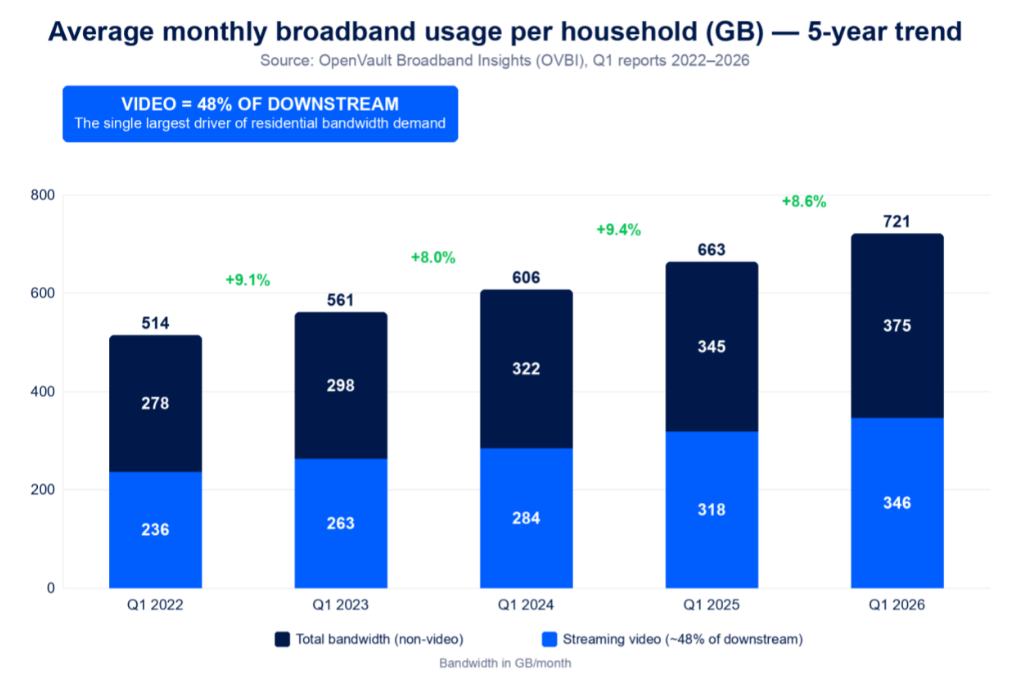
Figure 1: Average monthly broadband consumption per U.S. household has grown 40% over five years, with streaming video consistently accounting for nearly half of all downstream traffic. Data: OpenVault OVBI Q1 reports, 2022–2026.
The bulk double play model
“Double play” is telecom shorthand for bundling two services under one contract; in this case, internet and video, delivered by a single provider through one managed platform, using the same infrastructure and operational framework. When a provider has this capability, the property gains the ability to charge a technology amenity fee whose value is directly substantiated by the retail cost of the streaming services included in the package. Residents, in turn, receive an entertainment bundle that replaces the cost and complexity of curating their own content stack at retail.
Spectrum’s deployment model illustrates how this works in practice. Spectrum Ready delivers the managed Wi-Fi layer: pre-installed, always-on connectivity that eliminates truck rolls, supports smart building technology including leak detection and access control, and provides instant activation for residents alongside continuous network access for property operations. Spectrum’s TV Select packages then extend that same managed infrastructure into the content layer, providing top streaming app inclusion and aggregating traditional video content that is aggregated through the Spectrum TV App. Comscore’s CTV Intelligence measurement has identified the Spectrum TV App as the most-viewed streaming service in the United States on an hours-per-household basis and the highest-rated pay TV streaming app in the country.
What the package delivers to residents
The defining value is the streaming app inclusion. With TV Select Signature, residents receive ad-supported versions of HBO Max, Disney+, Hulu, ESPN Unlimited, Paramount+, Peacock, AMC+, discovery+, FOX One, and ViX while TV Select Plus also provides the Tennis Channel app. At current retail pricing, assembling the same app tiers included with TV Select Plus independently costs a household over $125 per month. All of it is included with the Bulk Video service at no additional cost to residents, accessible through a unified interface from the day they move in.
TV Select Signature builds on its streaming foundation with 150+ live channels, 85,000+ On Demand titles, and the Xumo Stream Box. TV Select Plus expands to 160+ live channels and adds Regional Sports Networks. Both tiers provide access to the Spectrum TV App across Roku, Apple TV, Fire TV, Google TV, Android TV OS, LG and Vizio Smart TVs, and iOS and Android mobile devices.
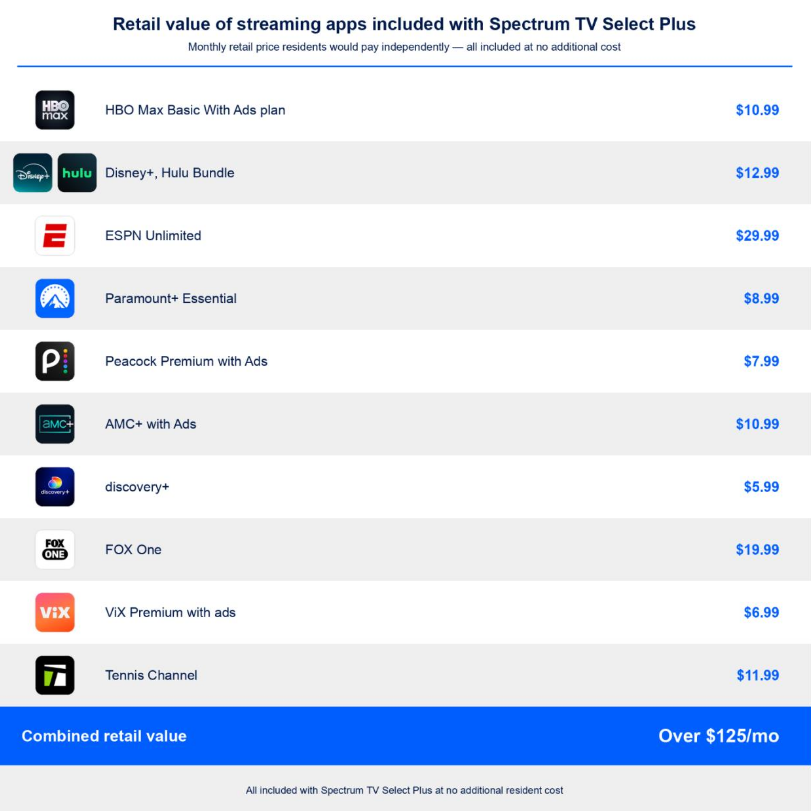
Figure 2: Streaming apps included with Spectrum TV Select Plus represent over $125 per month in retail value that residents would otherwise pay out of pocket. Properties delivering this value through a bulk agreement justify tech amenity fees while providing genuine, quantifiable resident savings.
Financial model and NOI impact
The financial model underlying the bulk double play is built on the spread between wholesale and retail pricing. Individual residents purchasing internet and streaming subscriptions independently pay full retail. Properties that aggregate purchasing power across all units through a single agreement acquire the same services at wholesale cost. A May 2026 study filed with the FCC by the Bulk Broadband Alliance found that bulk billing arrangements save multifamily residents more than 50% relative to comparable retail plans, with consumers collectively paying an estimated $5.6 billion more per year absent bulk pricing.
Parks Associates research shows the average technology amenity fee in multifamily today is $75 per month, typically covering bulk internet and smart home components such as access control, thermostats, and leak detection; 83% of residents paying these fees report they are worth the cost. Adding video and streaming to that same base substantiates a meaningfully higher fee, usually between $110 and $130 per month, because the delivered value to residents increases by over $125 in streaming services they would otherwise purchase independently. The resulting net margin of $75 to $85 per unit per month flows almost entirely to NOI once the managed infrastructure is operational.
At scale, a 250-unit community capturing the full $75 to $85 per unit margin generates $20,000 per month in net revenue, or $240,000 in annual NOI contribution. When capitalized at prevailing market rates, the asset value impact ranges from $4.0 million at a 6.0 cap to $4.8 million at a 5.0 cap. Of that total, the incremental lift attributable to video—the $35 to $55 per unit per month above what an internet-only fee supports—accounts for $2.25 million to $2.7 million in additional asset value that would not exist without the content layer. Internet-only bulk agreements remain sound and valuable, but properties that add video unlock a margin tier that connectivity alone cannot attain.
Retention and competitive differentiation
Communities delivering over $125 per month in included streaming value create a measurable switching cost for residents at renewal. Reassembling an entire streaming stack at full retail represents a tangible financial downgrade that factors into renewal decisions in ways that connectivity alone does not. It stands to reason that properties offering this kind of amenity value see it reflected in renewal decisions.
From a leasing perspective, the double play provides a concrete differentiator in a market where bulk internet has approached commodity status across Class A properties. Communicating that a lease includes TV Select Plus, providing over $125 in streaming services residents would otherwise pay for at retail, is a stronger leasing conversation than describing Wi-Fi speeds. The included content covers a wide range: ESPN Unlimited, Fox One, and Tennis Channel for sports, Disney+ for families, ViX for Spanish-language households, and HBO Max, Peacock, and Paramount+ and more for general entertainment.
Market conditions favoring adoption
Several converging dynamics strengthen the case for bulk video today. Bandwidth demand continues to accelerate across all subscriber segments, with the median subscriber now consuming 496 GB per month, a 12.1% year-over-year increase that confirms broad-based growth rather than heavy-user distortion. Properties provisioning managed network infrastructure are already absorbing the cost of video-driven bandwidth, and adding video to the bulk agreement captures revenue from capacity that has already been deployed.
Ad-supported streaming tier adoption has grown from 46% to approximately 70% of consumers between 2024 and 2026, and Spectrum’s TV Select packages deliver exactly those ad-supported apps. That shift changes the economics in the property’s favor: platforms now prioritize reach and engagement over premium subscription pricing, which is precisely the distribution model bulk agreements are built to capture.
Consumer appetite for bundling is documented and growing, with 42% of consumers explicitly preferring bundled services to standalone apps. The old cable bundle earned its criticism by forcing unwanted content. A modern bulk video offering, delivered through an app-based interface with on-demand content, provides the curated aggregation consumers are actively seeking without the legacy constraints that drove cord-cutting in the first place.
Conclusion
The integrated delivery of managed connectivity and premium entertainment through a single provider relationship represents the most complete realization of NOI through bulk agreements available today. Spectrum’s ability to pair Spectrum Ready as the connectivity foundation with TV Select Signature or TV Select Plus as the entertainment layer, combining top streaming app inclusion and traditional video content that is delivered through the Spectrum TV App across virtually every modern connected device, creates an architecture in which the property captures meaningful NOI from content that already dominates its network traffic while providing residents with substantial value and content aggregation. Residential video consumption is not slowing, content fragmentation drives rising costs for residents, and the properties that add content delivery to their bulk agreements are positioned to capture the maximum value of their investment.