

Viewpoint: EnGenius
In today’s connected world, Wi-Fi is no longer a convenience in multi dwelling units (MDUs). It is an expectation. Residents rely on constant connectivity for remote work, streaming, smart home devices, and everyday communication. For property owners and operators, delivering a high performance and secure wireless experience has become a key factor in attracting and retaining tenants.
However, traditional approaches to MDU networking are increasingly falling short.
The Challenge: High Density, High Expectations, and Rising Security Risks
MDU environments present a unique set of challenges. High user density means dozens or even hundreds of residents are connecting multiple devices at the same time, placing significant strain on network infrastructure. In addition, building materials, layouts, and floor plans often create coverage gaps and inconsistent performance.
Security adds another layer of complexity. Shared network names and passwords, which are common in many MDU deployments, introduce vulnerabilities that can compromise resident privacy and expose property owners to risk.
These challenges are compounded by rising expectations. Today’s residents expect seamless connectivity throughout their living space, not just in common areas or near hallway wireless access points. When these expectations are not met, dissatisfaction can quickly lead to tenant turnover and reputational damage.
Why Traditional Designs Fall Short
Many legacy MDU deployments rely on outdated infrastructure, poorly placed access points, and consumer-grade solutions such as hallway-mounted APs or wireless repeaters to extend coverage. While these approaches may reduce upfront costs, they often result in inconsistent performance, signal degradation, and increased interference—especially in dense environments.
Repeaters, in particular, can introduce latency, reduce throughput, and contribute to network instability. As the number of connected devices continues to grow, these limitations become more pronounced, leading to congestion and degraded user experiences.
The fundamental issue lies in network architecture. Traditional designs were not built to support the density, performance, and security demands of modern MDUs.
A Better Approach: In Room Connectivity by Design
To meet today’s requirements, MDU network design must evolve. A modern approach focuses on:
- In room coverage instead of hallway-based distribution
- Wired backhaul for improved reliability and performance
- Strategic access point placement to balance coverage and capacity
- Scalable infrastructure that grows with tenant demand
By placing access points directly within each unit, property owners can deliver stronger signal quality, reduce interference, and ensure consistent performance where residents actually use their devices.
This shift from shared coverage to unit level connectivity is a foundational change that significantly improves both user experience and network efficiency.
Enabling the Next Generation of MDU Wi-Fi
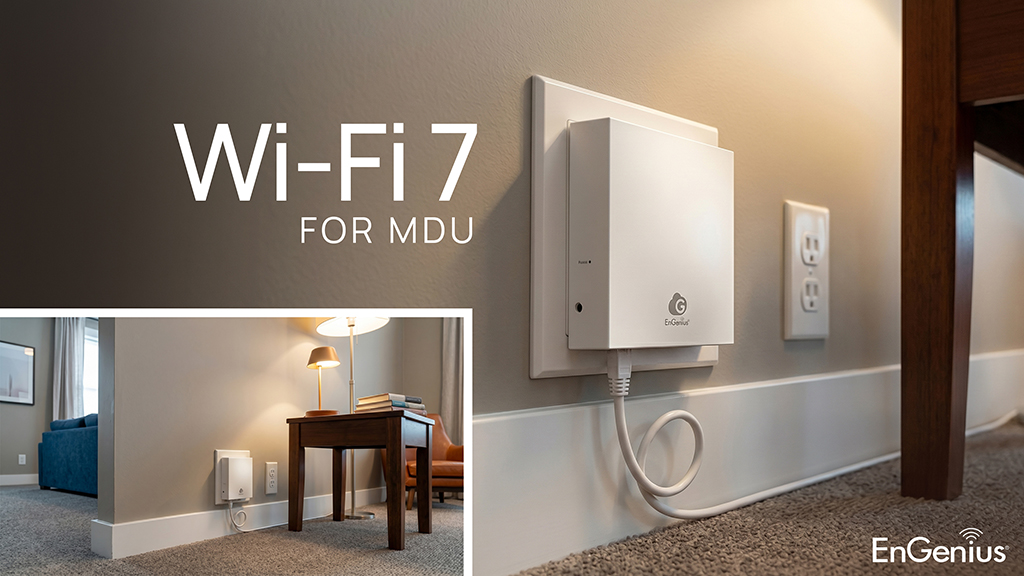
Technologies like the ECW515 Wi-Fi 7 wall plate access point are designed specifically to support this modern architecture. Installed directly within individual units, wall plate access points provide high performance, low latency connectivity exactly where it is needed. This eliminates dead zones and improves overall network reliability.
With Wi-Fi 7, these deployments support higher throughput, lower latency, and better performance in dense environments, ensuring networks are ready for the next generation of connected devices.
Equally important is how these networks are managed. Cloud based platforms enable centralized visibility, configuration, and troubleshooting, allowing IT teams and service providers to scale deployments efficiently across entire properties.
Securing the Network: Moving Beyond Shared Passwords
While performance is critical, security is equally important in MDU environments. Traditional shared password models are no longer sufficient, as they expose networks to unauthorized access and limit visibility into individual users or devices.
A more effective approach is per user or per device authentication.
With technologies like WPA3 and Multi Pre Shared Key (MyPSK), administrators can assign unique credentials to each resident or device while maintaining a single network name. This removes the need for shared passwords and enables:
- Individual access control
- Improved security and data privacy
- Simplified onboarding for residents
- Greater visibility and network management
This model aligns more closely with enterprise grade security practices, bringing a higher level of protection to residential environments.
The Outcome: Better Experiences for Residents and Operators
By combining in room Wi-Fi deployment, next generation wireless technology, and individualized security, property owners can transform the connectivity experience within their MDUs.
Residents benefit from:
- Faster and more reliable connections
- Seamless coverage throughout their living space
- Secure and private network access
Operators and IT teams benefit from:
- Simplified deployment and management
- Reduced support overhead
- Scalable infrastructure for future growth
A well-designed Wi-Fi network is no longer just a utility. It is a strategic asset that enhances property value, improves tenant satisfaction, and supports long term competitiveness in the rental market.
Summary
As MDUs continue to evolve, the networks that support them must evolve as well. The shift toward in room connectivity, Wi-Fi 7 performance, and per user security represents a meaningful advancement in how wireless networks are designed and deployed.
For property owners and service providers, the path forward is clear: move beyond traditional approaches and adopt a modern architecture that delivers secure, scalable, and high-performance connectivity, one unit at a time.