What happens when an off-campus student housing community begins to deliver the same seamless technology experience students have already come to expect on campus?
I previously interviewed Whitney Kidd, SVP of innovation and technology for Preiss, and Bri Kayser, sales and marketing lead at IRIS Technologies, the innovation and technology subsidiary of Preiss, to learn about the technology transformation that took place at The Collective at Norman, a 684-bed student housing community near the University of Oklahoma.
At Broadband Communities Summit in Houston, I also sat down with Ed Keathley, VP of product strategy at IRIS Technologies, and Bryan Rader, president of MDU for Pavlov Media, during our Great Communities session. We discussed how The Collective at Norman was the first full-scale deployment of the native mobile wallet experience, part of what Preiss describes as the first native mobile wallet access at scale for an off-campus student housing facility in the United States.
The story begins with broadband.
The existing network equipment was nearing end of life, and the property needed a connectivity foundation capable of supporting a much more connected resident experience. The internet upgrade, designed and implemented through IRIS Technologies in partnership with Pavlov Media, included a fiber-to-the-unit (FTTU) architecture using Active Ethernet, a dedicated 10-gigabit internet backbone, 10-gigabit uplinks to each IDF, and 1-gigabit connectivity delivered directly to each media panel or unit. Targeted resident speeds are up to 1,000 Mbps for downloads and 500 Mbps for uploads. The wireless environment, meanwhile, was also upgraded to Wi-Fi 6 using Edgecore access points, including 194 in-unit APs and expanded common-area wireless coverage. Remote monitoring, automated recovery capabilities, and extensive network testing were incorporated to improve reliability.
But broadband became the foundation for something bigger.
Preiss had already been moving its student housing communities toward a “mobile-first” access strategy, replacing traditional keys and fobs with smartphone-based access whenever possible. The reasoning was simple: students were already using their phones across campus for everything from building access to dining and events. Moving into off-campus housing and being handed a brass key felt like moving backward.
The Collective at Norman took that strategy further. Working with IRIS Technologies, Quext, and Allegion, the property installed 1,078 Allegion Schlage BE467 smart locks, seven Schlage RC Series electrified readers, 195 Quext smart thermostats and three Quext IoT LoRaWAN gateways. The system integrates mobile access, climate automation, centralized device management, and operational workflows.
“How do you make move-in and move-out easier? How do you make it so that, if residents don’t want to come to the office, they can go directly to their door? This was the missing piece. It was the access control.”
—Whitney Kidd, Preiss
Preiss and IRIS also spent approximately three years developing and refining a native mobile wallet experience specifically for student housing, working with Apple, Google, Quext, and Allegion. Residents can access doors, bedrooms, and shared amenities using Apple Wallet or Google Wallet on compatible phones and wearables, eliminating the need to open an app for every entry. Native wallet functionality can also continue operating when devices are offline or battery constrained.
The result is not simply a technology upgrade. It is a different resident and operational experience.
Access permissions can align with lease information and resident status, allowing credentials to be granted, changed, audited, and revoked centrally. Preiss reports a 100 percent reduction in after-hours lockouts at The Collective, while communities participating in its broader Mobile Wallet Experience have experienced a 38 percent reduction in access-related call volume.
At scale, across nine communities and approximately 5,000 beds, Preiss and IRIS estimate that the Mobile Wallet Experience produces approximately $698,000 in annual NOI lift, combining technology fees with reductions in overtime, key replacement costs, and onsite labor associated with access management.
For an industry increasingly focused on both resident experience and operating efficiency, The Collective at Norman offers a glimpse of how thoughtful integration of connectivity, access control, and smart-building technologies can create a more seamless community experience.
Vital statistics
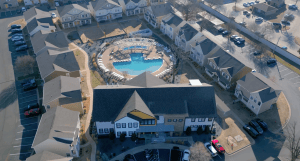
Property description: The Collective at Norman is a 194-unit, 684-bed off-campus student housing community located minutes from the University of Oklahoma in Norman. The cottage-style community offers two- to five-bedroom residences with private bedrooms and bathrooms, in-unit laundry, and spacious living areas. Amenities include a resort-style pool, a 24-hour fitness center, a study lounge, a game room, a dog park, controlled access, and a private shuttle to campus. High-speed internet and cable are included with monthly rent.
Greenfield or retrofit: Retrofit/value-add Number of units/beds: 194 units, 684 beds Internet infrastructure: Fiber-to-the-unit with Active Ethernet; dedicated 10 Gbps backbone; 10 Gbps uplinks to each IDF Resident internet speeds: Up to 1 Gbps download and 500 Mbps upload Wireless technology: Wi-Fi 6 using Edgecore access points
Lessons learned
What was the biggest success? Creating an integrated technology environment in which broadband, mobile access, and IoT work together to improve both the resident experience and property operations. The reduction in lockouts and access-related calls demonstrates that eliminating small points of friction can create meaningful operational value.
What should other owners consider before a similar deployment? Start with the infrastructure. Smart locks, mobile credentials and IoT devices depend on a reliable network foundation. Owners should also think beyond today’s application and consider lifecycle, interoperability, vendor diversity, and how technology can adapt as resident expectations evolve.
The Preiss and IRIS teams also emphasize disciplined testing rather than rushing innovation to market. Their mobile wallet initiative was developed over three years, allowing them to address the unique complexities of student housing before scaling the solution.
Services offered
Managed high-speed internet
Wi-Fi 6 connectivity
Fiber-to-the-unit architecture
Apple Wallet and Google Wallet access credentials
Mobile access for apartments, bedrooms and community amenities
Smart thermostats and climate automation
Centralized IoT and device management
Remote network monitoring
Automated network recovery capabilities
Centralized resident access and credential management
Valerie M. Sargent is a multifamily speaker, trainer and executive consultant, and is the multifamily news correspondent for Broadband Communities. Contact her at http://www.valeriemsargent.com.