
Reports
Press Release
As per Growth Market Reports, the global smart rural broadband tower market size in 2024 stood at USD 6.2 billion.
News provided by: Growth Market Reports
The global smart rural broadband tower market is demonstrating robust momentum, with a projected compound annual growth rate (CAGR) of 12.8% from 2025 to 2033.
By the end of 2033, the market is forecasted to reach USD 18.2 billion.
This growth is primarily fueled by the increasing demand for high-speed internet connectivity in rural areas, government initiatives to bridge the digital divide, and rapid advancements in wireless broadband technologies. The rising necessity for digital inclusion and the proliferation of smart devices in rural communities are further accelerating market expansion.
The market is also emerging as a vital segment within the global telecommunications infrastructure industry.
As governments, telecom operators, and technology providers focus on bridging the digital divide, rural connectivity has become a strategic priority. Millions of people living in remote and underserved regions still lack access to stable broadband services, creating a strong need for innovative tower solutions designed specifically for rural environments.
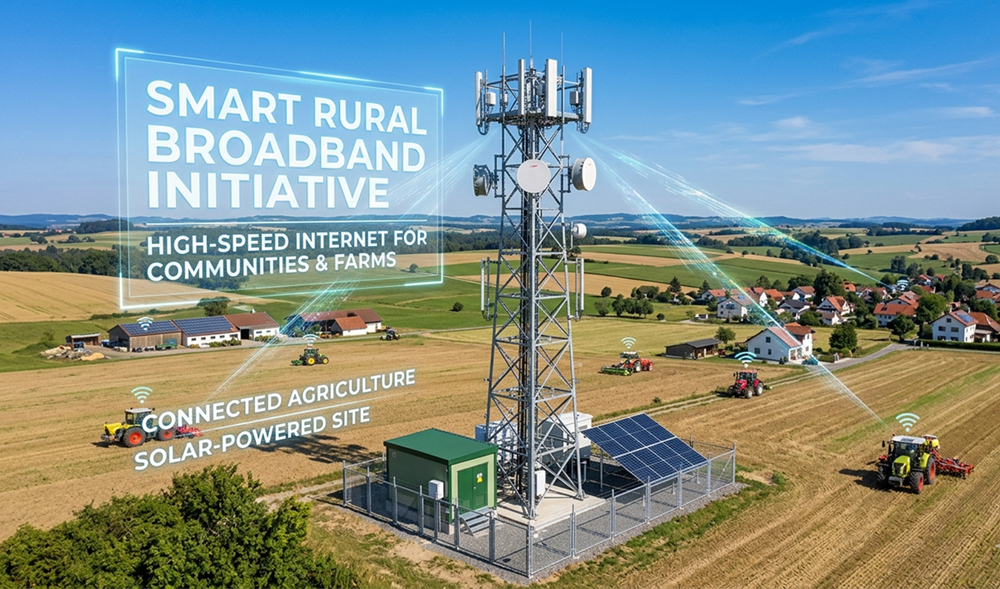
Graphic provided by Growth Market Reports
Smart broadband towers combine connectivity infrastructure with digital monitoring, renewable power systems, intelligent traffic management, and remote maintenance tools, making them highly suitable for dispersed populations and challenging terrains.
Rising need for rural digital inclusion
A major factor driving this market is the global push for universal internet access. Broadband is no longer viewed as a luxury but as essential infrastructure similar to electricity and roads. Rural households increasingly need internet access for remote learning, telemedicine, e-commerce, government portals, and communication. Businesses in agriculture, logistics, and small-scale manufacturing also rely on connectivity for productivity and market access.
Prominent companies operating in the market are:
- Huawei Technologies Co., Ltd.
- Nokia Corporation
- Ericsson AB
- ZTE Corporation
- Samsung Electronics Co., Ltd.
- American Tower Corporation
- Crown Castle International Corp.
- SBA Communications Corporation
- China Tower Corporation Limited
- Bharti Infratel Limited
- Indus Towers Limited
- AT&T Inc.
- Verizon Communications Inc.
Smart rural broadband towers solve the economics challenge of serving low-density populations by reducing operating costs and maximizing uptime through remote monitoring and automation. This makes network expansion more financially viable for telecom operators and infrastructure investors.
Government funding and public policy support
Public policy plays a major role in accelerating deployment. Many countries are introducing rural broadband subsidies, spectrum incentives, infrastructure sharing mandates, and public-private partnership models. These programs reduce capital risk for operators while speeding up tower rollouts.

Large-scale broadband investment plans by telecom firms also demonstrate confidence in network expansion, including rural zones where fixed and wireless access are being strengthened.
Technology advancements fueling growth
- Renewable energy integration
- Many rural areas face unstable grid access. Solar-powered and hybrid towers with battery storage reduce diesel dependency and improve sustainability. Renewable-powered towers also lower long-term operational expenses.
- Remote monitoring systems
- Sensors and cloud platforms track temperature, power consumption, intrusion attempts, equipment health, and traffic load in real time. This minimizes the need for frequent physical maintenance visits.
- Multi-band and multi-technology support
- Modern towers can host 4G, 5G, Wi-Fi hotspots, microwave radios, and satellite-linked equipment simultaneously. This flexibility enables operators to tailor connectivity models for each region.
- AI and predictive maintenance
- AI systems can forecast battery failures, optimize power consumption, and identify network congestion before outages occur. Such capabilities improve service quality while reducing maintenance costs.
Challenges in the market
- High initial capital costs
- Even efficient towers require investment in land acquisition, transport logistics, equipment, and backhaul connectivity.
- Terrain and accessibility
- Mountainous, forested, desert, or flood-prone rural regions increase deployment complexity.
- Low revenue density
- Sparse populations can extend return-on-investment timelines for operators.
- AISkilled workforce gaps
- Some remote regions lack trained technicians for maintenance and installation.
Future outlook
The future of the smart rural broadband tower market looks highly promising as connectivity becomes foundational to economic growth and social inclusion. Demand will increasingly shift toward autonomous, energy-efficient, multi-service towers that support both people and machines. As agriculture digitizes, healthcare becomes remote-enabled, and education moves online, rural broadband towers will serve as the backbone of connected communities.
Emerging technologies such as Open RAN, low-earth-orbit satellite integration, edge computing, and AI-managed rural networks are expected to further reshape the market. Towers may evolve into multifunction digital hubs supporting EV charging, surveillance systems, weather sensors, and community Wi-Fi zones.
Get this news in your inbox. Subscribe to the Broadband Communities newsletter!