

Contributed Article
In this article we look at the state of connectivity in affordable multifamily housing and how public-private partnerships can provide a successful and sustainable framework reducing the digital divide.
By: Adlane Fellah, Chief Analyst, Maravedis LLC
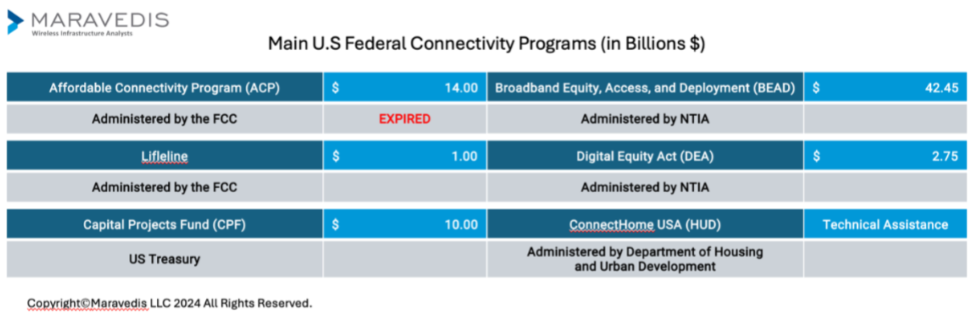
As of June 1, 2024, the Affordable Connectivity Program (ACP) ended due to a lack of additional funding from Congress; thus, previously eligible households no longer receive an ACP discount. Based on previous history, we—along with various other analysts—expect 25 percent of the 23 million ACP households to drop their connection, 25 percent to maintain it, and 50 percent to be on and off, depending on available deals.
The state of affordable housing
Per the National Low Income Housing Coalition, there are 7.1 million affordable units housing over 14 million people. While this article is not a report about affordable housing, most beneficiaries of affordable connectivity programs are residents of affordable housing communities, in particular multifamily dwellings.
The digital divide
According to the National Telecommunications and Information Administration (NTIA) latest’s research, 12 percent of people lived in households without any internet connection in 2023. For households whose annual incomes fall below $25,000, more than 40 percent lacked a wireline subscription as of 2022.
With monthly broadband bills averaging $50 to nearly $70 nationally—and sometimes reaching as high as $85 with taxes and fees—without subsidies, broadband access may be out of reach for these households. The 2023 American Community Survey (ACS) data from the US Census Bureau disclosed that nearly one-quarter of all US households did not have wireline high-speed internet subscriptions at home.
The digital divide can also result from outdated or lacking infrastructure. Much of the affordable housing stock predates broadband. For instance, 51 percent of public housing units were built before 1975. Additionally, some buildings have never been wired for broadband, while others have outdated wiring and use older technologies that cannot meet modern needs.
Lack of coordination of connectivity programs
There are more than 100 government-led broadband expansion efforts, which are currently administered by 15 different agencies with quite some overlaps and inefficiencies. While this report is not about government policies, the various programs described in this section have an impact on efforts to reduce the digital divide.
The Capital Projects Fund (CPF) program by the US Treasury has been quite successful—90 percent of the money was already disbursed to fund connectivity projects (in contrast to the more complex and slower BEAD programs which are yet to release any funds). The NTIA is managing the $42.5 billion BEAD program and the $2.75 billion Digital Equity Act programs, both of which are expected to be disbursed in 2025.
The ongoing FCC Lifeline program, which has 7.6 million participants—half of which are using it for their mobile service—only provides a fraction of what the ACP contributed; thus, it will not reduce the digital divide in the current conditions.
Connectivity requirements
Residents in affordable housing have the same connectivity requirements as anyone else in the country. Perhaps these residents own a lower number of devices, but their need for streaming, gaming, and teleworking is no different. The various managed service providers and property builders we spoke to indicated that the standard broadband offering is 100Mbps symmetrical, which sells at $30 using the extinguished ACP benchmark.
Broadband is important not only to residents, but also for the management and operation of affordable housing properties and the services that residents receive. Access control and camera surveillance are the two main IoT applications sought by affordable housing operators.
Current challenges
Some providers, including the managed service providers (MSPs) we interviewed, have announced either alternatives to ACP or that they would subsidize the $30 benefit themselves for a period of time but the latter is unlikely to go beyond 2024).
The end of ACP will have a negative impact on the implementation of BEAD programs. The ACP subsidy is critical to the success of BEAD as states are relying on the administrative infrastructure of the National Verifier to determine which households are eligible for a low-cost service option.
On top of this uncertainty, the FCC announced its proposal to ban bulk billing deals as they are deemed “bad” for consumers because they lock tenants into signing up with a specific internet service provider (ISP). Broadband providers are continuing to push the FCC to change course on its proposal to ban bulk billing arrangements in apartment buildings. This potential bulk internet ruling will have some unintended negative consequences on affordable connectivity.
A successful public-private partnership
Grants and subsidies are aimed to make the business case for providing affordable connectivity in affordable housing more attractive for all stakeholders. Generally speaking, the business case works if the capital expenditure required to switch on the internet in the building is paid for by the various government entities, and the property owner picks up the tab for the ongoing cost of operating the network as just another cost of running the building. Given the lower average revenue per user (ARPU) in the low $20s, contracts five years or more are needed for the service to be profitable for MSPs.

Maravedis’ assessment
Access to internet is now essentially a human right—practically the same as water and electricity. Low-income residents deserve to have as high-quality a network as everyone else, and at least a service that meets the FCC’s definition of “broadband”. We argue that Lifeline and other subsidy programs should be made eligible to bulk internet deals so as to encourage long-term, favorable deals, which benefit an entire property. Bulk internet, when done and priced right, removes any friction for the resident: no application, no credit check, no deposit, and no late fees.
Affordable connectivity can be a very lucrative market for managed service providers delivering reasonable, long-term, non-exclusive deals to property owners and meet both residents’ and management’s connectivity requirements for the 21st century at the most effective costs.
This article is based on findings from our latest report, “Managed Connectivity for Affordable Housing in the United States 2024-2029,” which includes interviews with leading service providers and property owners active in the market. It also includes market-sizing projections for managed services from 2024 to 2029.
Unlock networking opportunities and engage with property owners and community leaders at Broadband Communities Summit West, planned for Oct. 30-31 in San Diego. Click here to learn more.