


Events
An upcoming webinar in November plans to address the challenges faced by managed service providers (MSPs) and available solutions.
By: Adlane Fellah, Chief Analyst, Maravedis LLC
Communication service providers (CSPs) and managed service providers in particular have been growing steadily in the last few years as network as a service (NaaS) is becoming the preferred connectivity option for businesses, especially in multifamily connectivity. The NaaS model is driven by enterprises’ inability to keep up with the pace of innovations in the context of skilled labor shortages and a shortened equipment replacement cycle, which means financial pressure exists to move away from the traditional capital expenditure model.
MSP’s pain points
However ,as MSPs grow they are forced to manage Wi-Fi across multiple vendors and market segments, which is an expensive and complex task. We recently surveyed 65 MSPs who have shared their main point points with us:
- 65 percent find their current Wi-Fi platforms too expensive and complex to maintain
- 75 percent of MSPs are reliant on vendor-specific management systems, limiting flexibility and scalability
- Most MSPs are allocating significant budgets – between $200,000 and $500,000 annually – for management software customizations and integrations.
- 31 percent struggle to achieve a unified management interface across multiple vendors
- 32 percent cite a lack of skilled personnel as a major inhibitor to growth.
The pandemic represented an inflection pain point for various service providers and MSPs due to the supply chain issues that severely impacted their businesses. Many MSPs want to increase their control over their supply by working with more vendors. It is not surprising that achieving a single pane of glass to manage multiple vendors is the most sought feature by MSPs.
With opportunities come complexities
Service providers serve different market segments—from senior living to affordable housing, to conventional rental. Different hardware vendors typically serve each market vertically, and service providers must deal with incompatible, separate proprietary switches, controllers, and cloud solutions.
Typically, each hardware vendor provides features and form factors tailored for a particular client, use case, or vertical. The result for service providers is a complex and rigid network which has several issues:
- Service providers must invest time and money to learn and train employees for each platform
- Each vendor may or may not support new feature requirements from a service provider, who is at the mercy of the vendor’s roadmap and priorities
- Introducing new features and innovation is slower than in an open environment
- Service providers are “locked” by each vendor and cannot mix access points from different vendors using a single controller, making switching vendors almost impossiblef
As a result, service providers have a fragmented influence on the pace and shape of innovation affecting their business. That explains why service providers would prefer a more standardized and open platform that delivers the same base functionality across vendors and platforms, on top of which a new ecosystem will fast-track innovation.
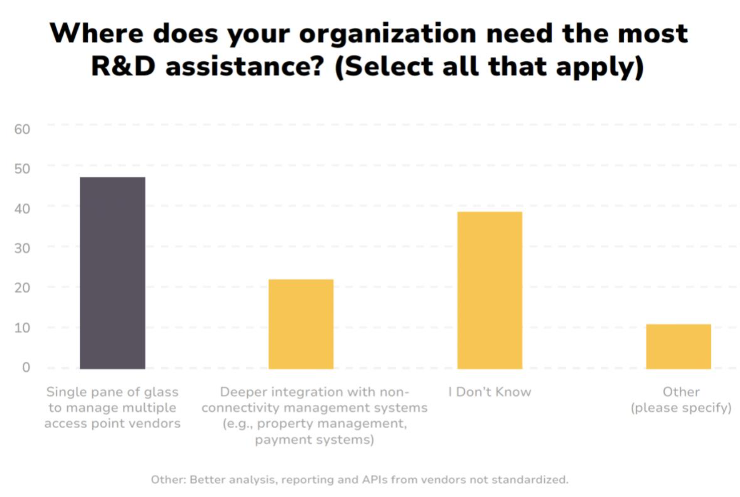
Source: Maravedis Research
While TIP Open Wi-Fi brings a new approach to the open concept, it does not solve the single pane of glass issue between incumbent vendors, which represent most of the installed base today.
CUPS is needed
The concept of control and user-plane separation (CUPS), which has transformed mobile networks, needs to make its way to the Wi-Fi industry. This separation of network management from data handling is paving the way for more flexible, scalable solutions. WiBUZ is one interesting company bringing those concepts to reality.
Conclusion
When it comes to managed service providers, 65 percent find their current Wi-Fi platforms too expensive and complex to maintain. As MSPs grow and enter new market segments — from senior living to higher education to multifamily units, they are forced to manage Wi-Fi across multiple vendors. It is not surprising that achieving a single pane of glass to manage multiple vendors is the most sought feature by MSPs. The concept of control and user plane separation (CUPS), which has transformed mobile networks, is now entering the Wi-Fi industry.
If you want to learn more about the challenges of MSPs, and what solutions are available to address them, join us for our upcoming webinar on November 12.
How is the US connectivity landscape shifting in 2024? Join the operators and their communities in discussion at Broadband Communities Summit West live in San Diego.