


Viewpoints
Exploring the future of coax and emerging technologies driving symmetrical, high-speed connectivity over traditional cable infrastructure.
By: Joseph Trouton, Senior Director, Product & Technology, Spectrum Community Solutions
Based on OpenVault’s Q4 2024 Broadband Insights Report, monthly average data consumption per household is estimated to be nearly 700 GB, a 45% increase from Q4 of 2020. This indicates that data consumption has grown at 10% on an annualized basis over the same period.

Source: OpenVault Broadband Insights Report, Q4 2024
In tandem with the increase in average usage, “Power Users” of data (those who consume more than 1TB per month) have grown by 505% since Q4 of 2020.
Along with this continued rise in data consumption—fueled by streaming video services, online gaming, and remote work—the need for reliable and robust broadband solutions is more critical than ever. In this ever-evolving landscape of broadband technology, coax cable infrastructure has proven not just resilient but also incredibly adaptable in the delivery of high-speed internet services to consumers and businesses alike. For nearly 30 years, DOCSIS (Data Over Cable Service Interface Specification) has been at the forefront of this evolution, undergoing continuous enhancements and improvements as data demands have steadily risen.
As we look to the future, advancements such as DOCSIS 4.0 and 5.0, and new deployment strategies utilizing Distributed Access Architecture (DAA), will continue to redefine the possibilities of coax networks, particularly when coupled with on-demand fiber optic deployment.
For almost three decades, DOCSIS has been the backbone of cable broadband, enabling high-speed internet access over coax networks. Each iteration of DOCSIS has introduced remarkable improvements in speed, efficiency and overall performance. With DOCSIS 3.1 already enabling gigabit speeds, enhancements in DOCSIS 4.0 are set to further elevate performance over a coax infrastructure.

Source: CableLabs
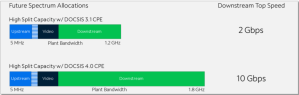
DOCSIS 4.0 introduces groundbreaking features like Extended Spectrum DOCSIS (ESD), which allows operators to utilize higher frequency bands (up to 1.8 GHz), significantly increasing the available bandwidth and enhancing overall network performance. This technology has the potential to deliver up to 10 Gbps downstream and 6 Gbps upstream, doubling existing capacity to meet growing consumer demands. With the potential to leverage existing coax, which passes the overwhelming majority of homes in the U.S., DOCSIS 4.0 provides cable operators with a cost-effective, minimally disruptive path to providing reliable, high-speed internet without the need for expensive rewires or overbuilding their plant with fiber to meet the burgeoning demands for speed and capacity.
The dawn of DOCSIS 5.0
Looking beyond DOCSIS 4.0, discussions around DOCSIS 5.0 are already underway. Although official specifications are yet to be finalized, the vision includes further enhancements in capacity, efficiency, reliability, and flexibility. It’s expected that DOCSIS 5.0 will build upon its predecessor’s capabilities, potentially supporting even higher throughput rates — possibly exceeding 20 Gbps downstream — by expanding delivery of DOCSIS beyond 1.8 GHz to 3 GHz or potentially even higher.
The role of fiber on demand
While DOCSIS and coax technology have remained powerful, there is also a move toward fiber deployment in the broadband space, often referred to as the fiber-first approach. The integration of fiber optics with coax networks is particularly evident with the deployment of Remote PHY Devices (RPDs). RPDs allow for the placement of fiber deeper into the network, connecting with coax infrastructure at a localized level, enhancing overall network performance, particularly in densely populated urban areas where demand is exceptionally high.
Source: Charter Communications internet plan of record
RPDs are currently utilized to enable delivery of DOCSIS 3.1 and 4.0 speeds, expanding the current spectrum over coax to 1.2 GHz and 1.8 GHz. Building on this transition is the Fiber on Demand initiative, which facilitates the seamless integration of fiber optics into existing coax networks. By utilizing existing node housings, operators can easily add microOLT (Optical Line Terminal) devices. These microOLTs can deliver symmetrical speeds of up to 25 Gbps to the home, significantly enhancing broadband capacity and performance to meet future demand.
The strategic deployment of microOLTs that coexist with RPDs will effectively enable operators to respond dynamically to shifts in utilization without a complete overhaul of the existing infrastructure, extending fiber further into the plant, further reducing congestion and improving service for end-users.
Conclusion
The future of coax will continue to be rewritten as data consumption steadily rises. As we’ve seen over the last 28 years, DOCSIS will remain at the forefront of network evolution as new technologies further the capacity and reliability of existing coax networks. With the constantly improving DOCSIS standard and complementary solutions such as Fiber on Demand, cable operators are poised to achieve unparalleled speeds and capacity. The coordinated efforts to enhance and innovate the coax platform promise to create a future where consumers enjoy faster, more reliable connectivity across a multitude of devices and services, reinforcing traditional coax network’s role in the digital age.
Get content like this delivered to your inbox. Subscribe to the Broadband Communities newsletter.
Learn more about Broadband Communities Summit 2025 in Houston.