


Bandwidth Hawk
Roth’s NTIA confirmation could come as early as April 7, but the Secretary of Commerce may be directed to swing his wrecking ball before then.
By: Steven S. Ross, Broadband Communities
Arielle Roth seems headed for an easy – and perhaps unanimous – confirmation as head of the National Telecommunications and Information Administration (NTIA) after a wide-ranging but barely contentious hearing by the Senate Committee on Commerce, Science and Transportation on March 27.
She has served the committee and its chair, Ted Cruz (R-TX), for years.
The NTIA is responsible for administering the Broadband Equity, Access, and Deployment (BEAD) Program, and tribal broadband access. It also advises the Pentagon and the Federal Communications Commission (FCC) on spectrum issues that have been frozen since the first Trump administration.
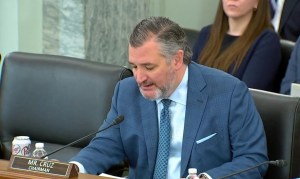
Sen. Ted Cruz speaks at a March nomination hearing for Arielle Roth. Screenshot
If Congress ever provides more funding (unlikely) to improve internet literacy, the NTIA will likely run the program.
If confirmed, Roth’s official title would be Assistant Secretary of Commerce for Communications and Information.

The confirmation hearing comes three weeks after the Secretary of Commerce, Howard Lutnick, in a March 5 press release, launched a “rigorous review” of BEAD and the program administering it.
As per Lutnick’s statement, the review will aim to eliminate previous requirements the current administration see as “pointless.”
“It is revamping the BEAD program to take a tech-neutral approach that is rigorously driven by outcomes, so states can provide internet access for the lowest cost,” Lutnick’s release stated.
Translation: Less fiber, more wireless, more satellites. The fiber industry and major carriers appear to be falling into line.
Notably, Lutnick did not wait for Roth’s nomination to clear the Senate before announcing his review.
Evan Feinman, who had directed the staff at NTIA implementing BEAD for the past two years, quit effective March 14, saying the program was tilting too much towards low-Earth satellite (LEO).
Roth wants to begin deployments quickly and efficiently
Roth, meanwhile, said she wanted to talk to the remaining staff before offering a firm opinion on the direction she would take. She was then able to deftly deflect probing questions on:
- Whether she would tell states that have accepted or are now accepting applications by broadband carriers to rethink over-reliance on fiber
- Whether there would be a larger role for low Earth orbit satellites, especially Elon Musk’s Starlink constellation
- Whether the Department of Defense’s refusal to give up spectrum in the 3, 6, and 7 GHz bands would hold
What she did emphasize was that she wanted deployments to begin as quickly and as efficiently as possible. She implied – strongly but not implicitly – that BEAD decisions would be made on a nuanced basis. That would be welcomed, compared to the meataxe one-size-fits-all approach at other agencies.

Those decisions would also extend to specific network electronics. Chinese giant Huawei was mentioned, in disgust, several times.
Democrats on the confirmation panel seemed to take that to mean Musk might get more BEAD business under Roth, but that other deployers would not automatically be shut out, especially if their applications are competitive, complete, or close to completion.
Also, even Musk opponents among on the committee admitted that there was a significant place for Musk with regard to BEAD funding. The product is much improved since BEAD was enacted in 2021 but also carries a higher price tag.
What’s next for Roth’s nomination?
Committee members have until Monday to transmit more questions to Roth. She has until the following Friday, April 4, to respond. A final vote on her nomination is likely to take place early the week of April 7.
One ugly issue was raised, based on a hearing earlier the same day that revealed the CIA and the Pentagon had meddled with altitude control radar at Reagan Washington National Airport a dozen times recently, interfering with commercial aircraft operations. To the committee, this revelation highlighted the need for the NTIA to referee and accelerate the division of spectrum between military and civilian uses.
The coast is clear for Roth, but the landing may be rocky.
Click here to view the full March 27 hearing.
Learn more about Broadband Communities Summit 2025 in Houston.
Also, click here to subscribe to the Broadband Communities newsletter.