

Viewpoints
By: Steven S. Ross, Broadband Communities
The massive increase in cost per premises passed, roughly triple that of earlier rounds, is already affecting ReConnect Program Round 5 policy. It should be a wakeup call for BEAD as well.
With the fifth round of the US Department of Agriculture (USDA) Rural Development ReConnect Program scheduled to open for applications March 22, it’s time to take a close look at Round 4 awards in the ReConnect Program. The USDA invested in 88 projects in the fourth round, totaling a bit more than $1.72 billion in grant and loan funding for high-speed internet, almost entirely fiber.
The 88 funded projects are to serve 94,147 households (over 200,000 family members) and 18,329 farms, businesses, and educational institutions across 13,668 square miles. The USDA thus provided grants and loans that covered a cost to the government per premises passed of $15,317, according to my calculations, detailed in Table 1, a downloadable spreadsheet file derived from USDA releases over all of FY23 and into the current budget year, FY24.
The cost per passing is far higher than in the first three rounds, which ranged from about $4,000 to $6,000.
The extra costs were due in large part to different funding rules, an emphasis on tribal broadband, and on customers in other low-income, low-density rural areas in round four. Far more farms, businesses and schools will be served by the fourth-round funding as well. But this is also evidence of a sharp rise in construction costs, shortages of labor and materials, and higher-than-previous interest charges accumulating before much of the network can be up and running for customer use.
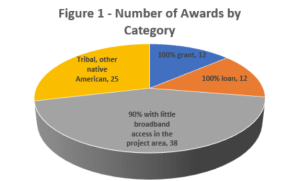
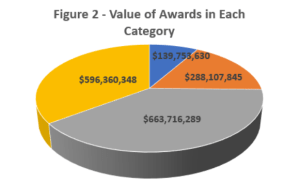
| ReConnect Program Round 4 by award type | Number of Awards | Service Area, Sq. Mi. | Household Premises | Other Premises | USDA Cost per premise | Award Amount |
| 100% grant | 12 | 1,833 | 12,833 | 1,348 | 9,855 | $139,753,630 |
| 100% loan | 12 | 2,484 | 24,467 | 5,533 | 9,604 | $288,107,845 |
| 90% with little broadband access in the project area | 38 | 6,152 | 32,315 | 7,208 | 16,793 | $663,716,289 |
| Tribal, other native American | 25 | 3,199 | 24,522 | 4,231 | 20,741 | $596,360,348 |
| TOTALS | 87 | 13,668 | 94,137 | 18,320 | 15,010 | $1,687,938,112 |
This does not bode well for the $42.5 billion Broadband Equity, Access and Deployment (BEAD) Program, administered mainly by newly formed state offices. Bluntly, there will not be enough money to get broadband everywhere it needs to go unless administrators sharpen their pencils.
USDA’s Rural Utilities Service (RUS) has some of the sharpest pencil pushers in government, going back to its formation to award grants for rural broadband starting more than 20 years ago with Hilda Legg as the service’s administrator. Already, it has served notice that most ReConnect Program Round 5 awards will require a 25 percent match by deployers. The maximum award will remain a generous $50 million, but don’t expect many at that level.
Round 4 of the ReConnect Program had four major award categories:
- Projects serving areas where 90 percent or more of the households lack sufficient access to broadband.
- Projects that include areas with persistent poverty and socially vulnerable communities.
- 100% grant awards for Alaska native corporations, tribal governments and colonias.
- Other rural areas with poor broadband service, eligible for grants, loans or combinations.
Awards were offered in the form of 100 percent grants or loans, and 50 percent grant/loan combo packages. Round 5 of the ReConnect Program will offer some loans at two percent and others at the same interest rate the United States Treasury pays on its newly issued bonds. ReConnect Program Round 4 loans were at two percent.
In Round 4 of the ReConnect Program, the largest award went to Craw-Kan Telephone Cooperative in Kansas, $49,954,702 for a fiber build covering 1,669 homes, 149 businesses, 821 farms, and three schools in Bourbon, Cherokee, Crawford, Labette, and Neosho counties, in an area of 632 square miles. The cost per premises passed will be almost $19,000, well above the average cost in this round and triple the average cost in previous rounds.
Beehive Telephone won the smallest award, to serve 10 households in the Goshute Land Area, part of Nevada’s White Pine County. The award was $596,496, which works out to almost $60,000 per home passed.
Scott County Telephone Cooperative in Virginia had the lowest cost per premises passed, just $3,026 for a network upgrade covering over 7,000 homes, 1,018 businesses, 37 farms and 49 educational facilities. This project will serve socially vulnerable communities across 50 square miles in Norton City, Wise County and Lee County, at a total USDA cost of $25 million.
The highest cost per connection on paper – not in reality – is Cordova Telephone Cooperative’s project serving nine homes, eight businesses, and one educational facility in Alaska’s Hoonah-Angoon Census Area. The price tag is $34.9 million. That’s almost $2 million per connection. But the project also includes an undersea fiber cable that accounts for almost all of the cost. The cable design and project management contract went to Pioneer Consulting in New Jersey. The more than 170 mile-long system will connect the cities of Cordova and Seward, with branches for additional connectivity to Johnstone Point and the Village of Chenega.
 Removing that one project from the Round 4 calculations drops the average per-premises passing cost by $300, to just over $15,000.
Finally, there has been some noise in Congress about publicly-owned broadband providers getting an advantage. But in this round, only eight winners were public – either municipal systems or public utility districts. Tribal ownerships are tricky but most tribal awardees are co-ops, owned by their customers. Only five tribal entities among the awardees are not co-ops.
Co-ops overall did well in the awards competition, getting 26 projects funded. Corporations, also identified as LLCs, snagged 49.